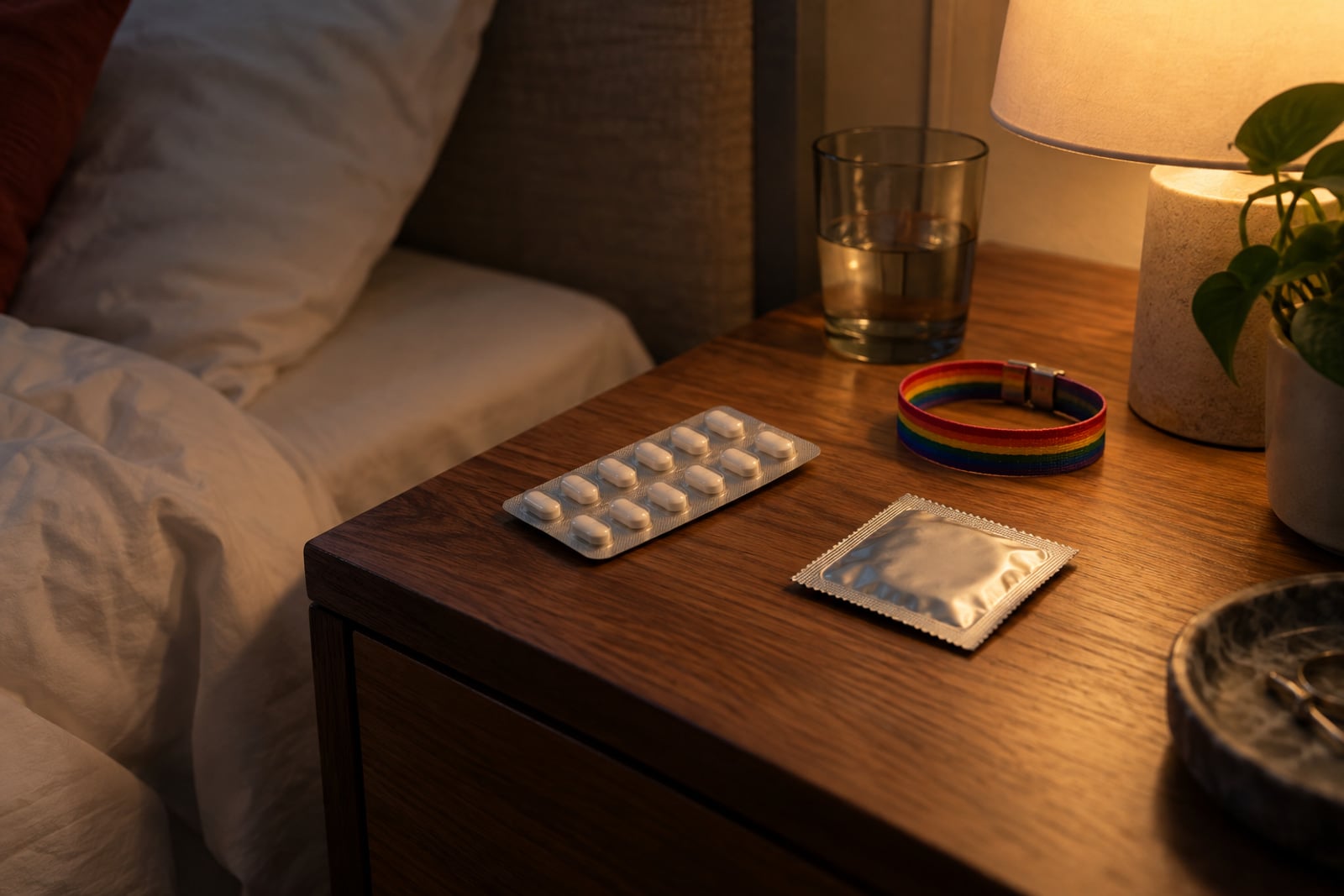
Doxy-PEP in Switzerland: who can now be offered the after-sex antibiotic
Since March 2026, Switzerland has its first official recommendation on doxy-PEP. We explain who the federal commission says should be offered it, how well it protects against syphilis and chlamydia, why it does little against gonorrhoea and who pays for it.
A Swiss line for the first time
Doxy-PEP stands for doxycycline post-exposure prophylaxis: after sex without a condom, you take a single dose of the antibiotic doxycycline to prevent a bacterial sexually transmitted infection (STI). It has been debated abroad for years, and several countries have their own recommendations. Switzerland, for a long time, had no official guidance.
That has now changed. The Federal Commission for Issues relating to Sexually Transmitted Infections (FCSTI; EKSI in German, CFIST in French and Italian), which advises the Federal Office of Public Health (FOPH), adopted a recommendation on the use of doxy-PEP on 19 March 2026. The FOPH published it on 2 April 2026 on its page of guidelines on HIV and other STIs. It is professional guidance for doctors and counselling services, not a law: it is meant to help them decide, case by case, whether or not to prescribe.
According to the commission, the trigger is very practical. For several years, healthcare professionals have noticed that men who have sex with men (MSM) are asking for doxy-PEP more and more often, frequently informed by recommendations from other countries. Some get hold of the drug without a prescription, for example online. The commission therefore wants two things: less uncertainty in clinics and less uncontrolled use outside the healthcare system.
Some figures for context: according to the FOPH's infectious diseases portal, Switzerland recorded 12,707 reported cases of chlamydia in 2025, 1.3 per cent fewer than the year before. Gonorrhoea reached 6,894 cases, practically the same as in 2024, and syphilis 1,167 cases, up 2.9 per cent (data checked in October 2026). These figures cover the whole population, not only gay and bisexual men, and they only show diagnoses that were reported.
What the studies show, and where they stop
The commission bases its view on a review of the evidence published in 2025. Its meta-analysis pools three randomised trials that are applicable to Switzerland. Participants were MSM and trans women who were either living with HIV or taking HIV PrEP. The result, scaled to 1,000 people at high risk of STIs: with doxy-PEP you would expect 59 instead of 180 chlamydia infections and 25 instead of 98 syphilis infections. That cuts the risk to roughly a third for chlamydia and roughly a quarter for syphilis.
Gonorrhoea, also known as the clap, is a different story. In the meta-analysis, doxy-PEP showed no statistically significant reduction; only one of the trials found any fall at all. The reason: many gonococci are already resistant to doxycycline. In cis women, the only trial so far could not show a benefit, because participants took the drug too irregularly.
There is now Swiss data, too. In an observational study within the Swiss HIV Cohort Study (SHCS), run from November 2023 to December 2024, 157 men living with HIV who have sex with men were followed for a median of 253 days. As the European Medical Journal reported from the presentation at the European AIDS Clinical Society congress in October 2025, the rate of all bacterial STIs, compared with the previous three years, fell from 56.26 to 30.23 cases per 100 person-years. The drop was clearest for chlamydia and syphilis; for gonorrhoea there was no protection. An observational study like this, without a randomly assigned comparison group, carries less weight than a randomised trial, though.
Just as important is what doxy-PEP cannot do at all. The Swiss AIDS Federation points out that the antibiotic works neither against HIV nor against viruses passed on during sex, such as hepatitis A and B, herpes, HPV or mpox. And even for syphilis and chlamydia, protection is not complete: infection remains possible, especially if the bacteria are resistant to doxycycline.
Who the commission has in mind
The commission explicitly opposes uncontrolled use and distinguishes three groups. For the first, it issues a conditional recommendation in favour. This covers MSM and trans women who have sex with men, who have oral, anal or vaginal sex without a condom with changing partners, and who have had at least one bacterial STI in the twelve months before starting. All three conditions must apply. For this group, the commission writes that a doxy-PEP prescription "should be offered". The decision is made together with the doctor, weighing benefits and costs. Protection against HIV, such as PrEP or PEP, should always be offered at the same time.
For the second group, the commission stays neutral: doxy-PEP can be considered case by case, but evidence from randomised trials is missing. This includes MSM and trans women at increased risk but without an STI diagnosis in the past year, with people who have group sex or chemsex named explicitly. The group also covers cis women and heterosexual men with changing partners and condomless sex, people who engage in paid sex, people with an indication for HIV PEP, and people who have been raped, who can be offered doxy-PEP alongside HIV PEP.
The commission is firmly against it for people without an increased risk of bacterial STIs, for instance in a monogamous relationship or after sex with a condom. As contraindications, the commission lists allergies and intolerances, and pregnancy.
Two principles run through the whole paper. First, doxy-PEP belongs in a one-to-one counselling conversation that also covers PrEP, PEP, condoms and vaccinations. Second, anyone given an off-label prescription must be informed about the risks, side effects and the open questions about the microbiome and resistance, and this should be documented in writing.
How the recommendation describes taking it
The commission also sets out the regimen a prescription is based on. It is not a do-it-yourself plan but the framework your clinician goes through with you. It foresees a single 200-milligram dose of doxycycline, ideally within 24 hours and no later than 72 hours after condomless sex. No more than 200 milligrams should be taken in 24 hours, even if there was sex with several partners on the same day. Where the risk is ongoing, the recommendation says a dose every 72 hours can be considered.
The side effects are well known from long experience with doxycycline, for example in malaria prevention or acne treatment. In the trials, the most common were stomach and gut complaints, and allergic and phototoxic skin reactions. The Swiss AIDS Federation stresses that doxycycline makes the skin much more sensitive to light; according to the organisation, UV protection is essential and strong sun should be avoided. Antibiotics can also cause allergic reactions and upset the balance of the gut flora. According to the Swiss AIDS Federation, taking doxycycline with alcohol or other psychoactive substances can make it less effective and increase side effects.
One point is often overlooked: according to the Swiss AIDS Federation, taking doxycycline can lengthen the diagnostic window for syphilis and chlamydia. An infection may then only become detectable later. If you take doxy-PEP, mention it at your next appointment so that testing and treatment can be adjusted. The organisation recommends taking doxycycline only under medical supervision and together with regular STI testing.
Resistance: the bill nobody can total yet
The biggest reservation is not about the individual but about everyone. Taking an antibiotic regularly encourages resistance, both in the STI bacteria themselves and in other bacteria. The commission cites studies linking doxy-PEP to the emergence of resistant gonococci, including lineages that have spread worldwide and are also associated with resistance to other important antibiotics. Resistance in Staphylococcus aureus and other bacteria has been described as well. The randomised trials themselves cannot settle the question, because too few samples were analysed.
The commission therefore weighs things up on two levels. For certain individuals, it judges that the benefits outweigh the harms. For the population as a whole, the balance is currently unclear, which is why it does not recommend broad use. It considers the effect on antibiotic resistance in Switzerland to be small for now, because only a few people want to use doxy-PEP and the amounts involved are small compared with overall doxycycline use. Negative effects cannot be ruled out, though. Developments should therefore be monitored, for instance in the existing SwissPrEPared and SHCS cohort studies, and in light of large international studies.
At European level the message is similar. The European Centre for Disease Prevention and Control (ECDC) published public health considerations on 19 January 2026. The ECDC recommends that decisions on doxy-PEP be made case by case, following clinical judgement and national guidelines, and does not recommend population-level use at this time. The document is meant to support countries that are considering doxy-PEP as part of a comprehensive sexual health strategy for MSM and trans women at high risk of syphilis. The ECDC notes that resistance can also affect people in the same sexual network who do not take doxycycline themselves, and that recommendations across Europe differ widely.
Prescription, cost, and why buying online is no shortcut
In Switzerland, doxycycline is not licensed to prevent STIs. Doxy-PEP can therefore only be prescribed off-label, and according to the commission the cost is borne by the people using it; health insurance does not reimburse the drug for this purpose. It is not expensive: the Swiss AIDS Federation puts the generic at around 15 francs for ten tablets; depending on the strength (100 or 200 milligrams), one dose is one or two tablets.
Cheap does not mean casual, though. It is precisely because some people get the drug online without a prescription that the commission wrote its recommendation. Taking it should be part of medical follow-up, with proper information, regular testing and HIV protection. Getting doxy-PEP online without a prescription takes you out of exactly that follow-up, and with it the check-ups that would catch an infection in time despite doxy-PEP. For medicines ordered online from abroad, the Swiss AIDS Federation says there is no guarantee about the active ingredient, the dose or other harmful substances.
For many people, the obvious place to raise it is wherever they already get tested. If you take HIV PrEP daily, SwissPrEPared recommends a check-up every three months with an STI test. Since 1 July 2024, basic health insurance has covered the drug, medical services and lab tests for PrEP under certain conditions, minus your share of the costs; one of them is that the practice or centre is linked to SwissPrEPared. The Checkpoints in Zurich, Bern, Basel, Lucerne, Geneva and Lausanne also offer sexual health advice, as do the infectious diseases clinics of the major hospitals, such as the HUG in Geneva, the CHUV in Lausanne and, in Ticino, the Ospedale Regionale di Lugano and the Ospedale Regionale di Locarno. Each service decides for itself whether and how it prescribes doxy-PEP. The simplest approach: ask directly when you book an appointment.
Sources & background
- Eidgenössische Kommission für Fragen zu sexuell übertragbaren Infektionen (EKSI) – Empfehlung zum Einsatz von Doxycyclin als Postexpositionsprophylaxe (Doxy-PEP) in der Schweiz ↗Eidgenössische Kommission für Fragen zu sexuell übertragbaren Infektionen (EKSI) · Accessed October 7, 2026
- Bundesamt für Gesundheit (BAG) – Richtlinien und Empfehlungen zu HIV und anderen sexuell übertragenen Infektionen ↗Bundesamt für Gesundheit (BAG) · Accessed October 7, 2026
- BAG – Federal Commission for Issues relating to Sexually Transmitted Infections (FCSTI) ↗BAG · Accessed October 7, 2026
- BAG – Infoportal übertragbare Krankheiten (IDD), Übersicht 2025 ↗BAG · Accessed October 7, 2026
- Aids-Hilfe Schweiz – DoxyPEP ↗Aids-Hilfe Schweiz · Accessed October 7, 2026
- SwissPrEPared – Häufig gestellte Fragen (Visiten & Kontrollen) ↗SwissPrEPared · Accessed October 7, 2026
- ECDC – Public health considerations on the use of doxycycline for post-exposure prophylaxis for bacterial sexually transmitted infections in the EU/EEA ↗ECDC · Accessed October 7, 2026
- European Medical Journal – EACS 2025: Doxy-PEP cuts chlamydia and syphilis risk in men living with HIV ↗European Medical Journal · Accessed October 7, 2026
Last checked: